Pilot at a Glance
Setting: Ontario Correctional Institute (Brampton, ON)
Format: 8-week structured program (2 closed groups, 16 matched evaluations)
Coping Skills: Perceived ability to calm down when overwhelmed jumped from 31.3% to 81.3%
Stress Reduction: Self-reported stress dropped immediately after every session, alongside a downward trend in baseline stress across the program
Participant Rating: 100% rated the program positive or very positive (65% "very positive")
Overview
How can sound-based learning create opportunities to explore stress and emotional regulation in a correctional setting?
In summer of 2026, Culture of Calm delivered an eight-week Sound Mindfulness Program pilot to two groups of residents at Ontario Correctional Institute (OCI) in Brampton, Ontario.
The program combined sound-based activities, mindfulness, grounding techniques and educational discussions to explore how participants recognize stress, respond to their internal states and develop strategies they may find useful in everyday life.
Designed to complement existing programming and work within the limitations of a secure environment, the pilot explored an approach that combined education and direct experience. Participants were introduced to concepts related to stress and emotional regulation, then given opportunities to explore those concepts through sound, reflection, discussion and practice.
To better understand the program's impact, we gathered participant feedback and measured changes in perceived emotional regulation and stress throughout the pilot.
The findings were encouraging, offering initial insights into the potential of sound-based mindfulness as a complementary approach to existing programming, and how experiential learning can support the development of skills related to stress management and emotional regulation in a correctional setting.
Why Sound-Based Learning?
Self-regulation is often discussed as a skill to understand and develop. But knowing about stress and experiencing ways to respond to it are not necessarily the same thing.
Sound-based learning offers an opportunity to connect the two.
Through mindful listening, rhythm, repetition, guided relaxation and hands-on exploration, sound can provide a tangible starting point for learning about attention, stress awareness and individual responses to sensory experiences.
It can also offer an accessible entry point for people with different educational backgrounds, levels of literacy and prior experience with mindfulness. The instruments used in this program were beginner-friendly and required no formal musical training. Participants could engage through listening, observing, experimenting, discussing or actively participating.
The intention was not to assume that sound would be calming for everyone. Rather, it was to create opportunities for participants to notice their own responses, explore different options and consider which practices felt useful to them.
The Approach: Combining Learning and Experience
The Sound Mindfulness Program was structured around eight themes:
Awareness: Noticing our relationship with sound and our responses in the present moment.
Curiosity: Exploring how sound influences our thoughts, emotions and sensations.
Sound as Regulation: Exploring how sound and breathing may help us manage stress.
Choice: Discovering personal preferences and how different sounds affect us.
Patterns: Recognizing patterns in our thoughts, emotions and responses to stress.
Autonomy: Exploring personal agency through choice and participation.
Independence: Building ownership through collaboration, decision-making and creative expression.
Integration: Reflecting on what we've learned and how we might apply it beyond the sessions.
Each theme provided a framework for exploring self-regulation through a combination of educational discussion and experiential activities.
Sessions brought together two complementary modes of engagement:
Active learning included guided discussions, reflection, hands-on exploration of instruments, experimentation and opportunities for participants to contribute to or lead activities.
Experiential sound practices included guided listening, sound-based relaxation and breathing techniques that gave participants opportunities to pause, observe their responses and experience the practices directly.
This mixed format was an important part of the program. Rather than relying exclusively on instruction or passive listening, sessions moved between learning about a concept and experiencing it in practice.
Participants could engage with the material in different ways, whether by listening, asking questions, trying an instrument, reflecting on their responses or sharing observations with the group.
The approach was informed by trauma-informed principles, including transparency, collaboration, empowerment, voice and choice, and a strengths-based, compassionate facilitation style.
What We Measured
To better understand the program's impact and explore the potential of sound-based learning in a correctional setting, we gathered participant feedback and measured changes in perceived self-regulation and stress throughout the eight-week pilot.
The evaluation focused on three areas:
Self-regulation: Changes in participants' perceived ability to calm themselves when overwhelmed.
Stress: Changes in self-reported stress before and after sessions, as well as trends over the course of the program.
Participant experience: How participants experienced the program, what they felt they gained and how they responded to the approach.
The findings were encouraging, offering initial insights into the potential of sound-based mindfulness as a complement to existing stress management and emotional regulation programming.
As a pilot without a comparison group, the evaluation provides an initial picture of participant-reported outcomes rather than definitive evidence that the program alone caused the changes observed.
Key Findings
1. Participants reported a greater ability to calm themselves when overwhelmed.
Among the 16 participants with usable matched pre- and post-program responses, the average rating for perceived ability to calm themselves when overwhelmed increased from 3.19 to 3.94 out of 5.
The proportion of participants who selected “Agree” or “Strongly Agree” to this statement increased from 31.3% to 81.3%.
This was one of the clearest changes observed in the evaluation. It suggests that participants perceived an improvement in their ability to access calm when overwhelmed, although further evaluation would be needed to understand whether this change persists and how it translates into everyday situations.
2. Participants reported lower stress following sessions.
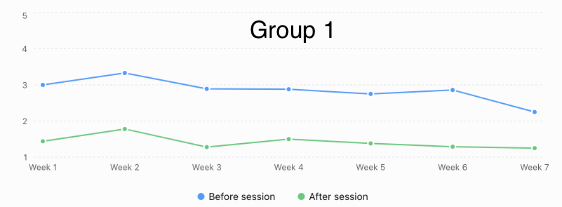
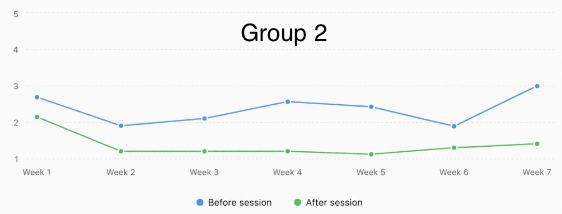
Weekly assessments showed reductions in self-reported stress immediately following sessions, alongside a general downward trend in pre-session stress over the course of the program.
The immediate reductions suggest that participants tended to report feeling less stressed at the end of a session than at the beginning. The broader trend in pre-session ratings also raises questions about the potential value of repeated opportunities to practice and reflect.
Further evaluation would be needed to determine what contributed to these changes and whether they continue beyond the program.
3. Participants rated the program positively.
All 17 respondents to the post-program questionnaire rated their experience as positive or very positive, with 65% rating it very positive.
Participants reported benefits that included feeling calmer or more relaxed, developing new coping strategies, managing stress and gaining a greater understanding of how sound affects them.
These responses suggest that participants valued the experience and perceived benefits across several aspects of the program, from immediate relaxation to learning about their own responses to sound and stress.
4. The combination of learning and experience was an important feature of the program.
Alongside the quantitative findings, we observed how participants engaged with the mixed-format approach.
Over time, participants became increasingly comfortable sharing their experiences, experimenting with unfamiliar practices and taking ownership of activities, including leading practices themselves.
The combination of education, discussion, reflection and sound-based experiences offered different ways to participate. Participants were not limited to listening to sounds or receiving information; they could also ask questions, try practices, make choices and contribute to the learning process.
This was an important aspect of the program's design. The educational component provided context for the activities, while the experiential component created opportunities to explore concepts directly.
Together, these approaches offered a way to engage with self-regulation that was both informative and experiential.
Why This Work Matters
Recognizing stress, managing emotional responses and knowing how to respond under pressure can be important in everyday life, including navigating relationships, making decisions and managing workplace demands.
For people preparing to reintegrate into their communities, these are meaningful skills to explore. The ability to recognize when stress is building and identify strategies that may help can be relevant to employment, interpersonal relationships and day-to-day functioning.
This is where experiential learning may offer a complementary approach. Rather than only discussing self-regulation as a concept, participants have opportunities to notice, experiment and practice within a structured environment.
The pilot does not establish long-term effects on reintegration or other behavioural outcomes. However, its findings provide an encouraging starting point for further exploration of sound-based learning as a complement to existing programming in correctional settings.
The mixed-format approach also raises a broader consideration for institutional learning: people engage with and process information in different ways. Some approaches place greater emphasis on verbal discussion, cognitive processing or written reflection. Experiential activities offer another point of entry, allowing participants to explore concepts through listening, sensory experiences and hands-on practice.
Combining educational and experiential approaches can create additional opportunities for people to engage with concepts and practice practical skills, without requiring prior musical experience or familiarity with mindfulness practices.
Looking Ahead
The Sound Mindfulness Program pilot offered an opportunity to explore how sound-based learning could be introduced in a correctional treatment setting, with an emphasis on practical skills, participant choice and experiential engagement.
The findings were encouraging: participants reported greater perceived ability to calm themselves when overwhelmed, lower stress immediately following sessions and overwhelmingly positive experiences of the program.
The experience also reinforced the value of combining education with direct experience. Sound-based activities were not simply a relaxation component; they formed part of a broader learning process that included discussion, reflection, experimentation and participant leadership.
Further evaluation could explore whether these perceived changes are sustained over time, how participants apply the practices outside sessions and how sound-based learning can best complement existing institutional programming.
For Culture of Calm, this work reflects a broader interest in how sound can be applied intentionally to support human experience — and how creative, experiential approaches can offer additional ways to explore skills that matter in everyday life.
Acknowledgements
Culture of Calm would like to thank Dr. Dave Gussak for his guidance and support in the early development of this initiative; Tina Jia for her contributions as Program Assistant throughout the pilot; and Ontario Correctional Institute for the opportunity to deliver and explore this program.